Spec-Driven Development: How I Stopped Vibe Coding with AI
What Spec-Driven Development (SDD) is, why it became the standard way to work with AI coding agents, and the lessons I learned running a full spec-to-ship pipeline on a real project.
 Elyor Djalalov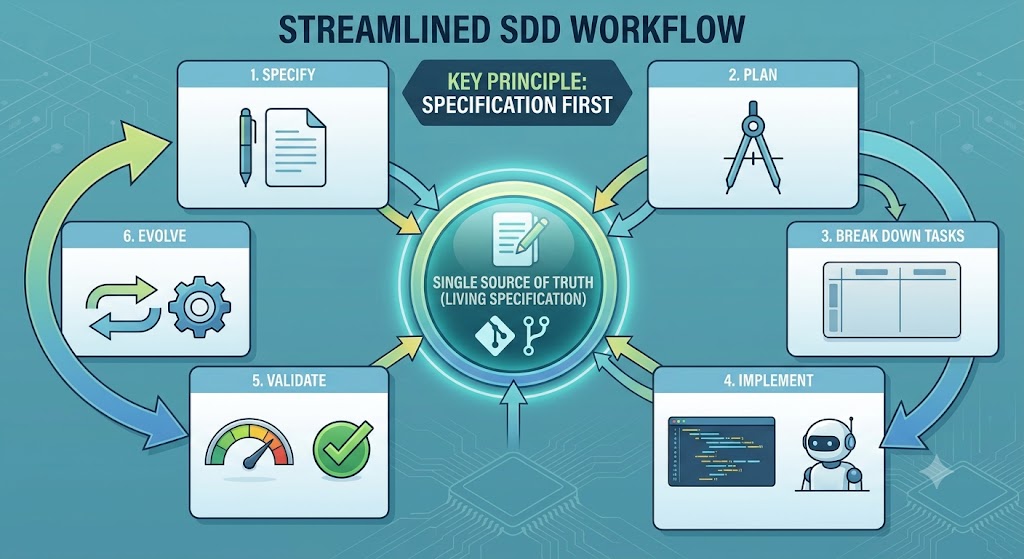
AI coding agents are great at writing code. They are terrible at guessing what you meant.
That single sentence explains why Spec-Driven Development (SDD) went from a niche idea in 2025 to a mainstream practice today. Every major AI coding tool — GitHub Spec Kit, AWS Kiro, Claude Code, Cursor, OpenSpec — now ships its own flavor of it.
I have been running a full SDD workflow on a production-grade side project for months. This post explains what SDD is, why it works, and what I learned from actually living with it — including the parts that are harder than the blog posts admit.
What Is Spec-Driven Development?
In SDD, a written specification — not the code — is the primary artifact. The workflow looks like this:
- Write a spec describing what the system should do, its constraints, and what “done” means
- Derive a plan that breaks the spec into small, verifiable tasks
- Generate code (with AI assistance) against the spec and the tasks
- Verify the result against the spec — tests, review, acceptance criteria
- When requirements change, edit the spec first, then regenerate or update the code
The spec stays alive. It is version-controlled, reviewed, and cited by the code that implements it.
Why It Emerged
SDD is a direct response to the failure mode of “vibe coding” with large language models. When you drive an agent through a long, meandering conversation, three things happen:
- The agent produces plausible code that drifts from your intent
- Context gets lost between sessions, so decisions get re-made differently each time
- The codebase decays as inconsistent patterns pile up
A spec fixes ambiguity once, in writing, before generation. Instead of correcting the agent turn by turn, you give it a fixed contract to code against. The conversation gets shorter and the output gets more consistent.
How My Pipeline Works
On my project, SDD is not a document template — it is the operating model. The delivery pipeline is a chain of commands:
/spec → /plan → /tdd → /implement → /review → /verify → /shipEach step produces a real artifact:
/specdrafts a specification from a standard template into a dated folder. It goes through an “interview” phase where the AI asks clarifying questions, and the spec moves from Draft to Approved before any code is written./planturns the approved spec into a task list, with each task linked back to a spec section./tddand/implementgenerate code test-first, following the RED → GREEN → REFACTOR cycle./reviewruns a two-stage review: spec compliance first (did it build the right thing?), then code quality (is it built well?)./verifyis a hard gate: lint, types, tests, and build must all be green./shiphandles the commit, PR, and release checklist.
Around this pipeline sit three supporting layers:
1. A Written Knowledge Base
Specs do not exist in a vacuum. They cite Architecture Decision Records (ADRs) and numbered coding standards. My project currently has 14 ADRs and around 60 indexed standards across nine domains. When a spec says “Do NOT bypass the 3-layer pattern” or “Must validate stage transitions server-side”, the agent codes against fixed rules instead of inventing its own.
ADRs are immutable — a new decision supersedes an old one, it never rewrites it. That gives you a traceable history of why things are the way they are.
2. Enforcement Hooks
Documentation alone does not constrain an AI agent. Six automated hooks run on every file write:
- A secret scanner blocks credentials from ever entering the codebase
- Formatters and linters run automatically on TypeScript changes
- Database migrations are safety-checked before they land
- Affected tests run immediately after edits
- Bundle size is monitored so regressions surface instantly
This is the always-on guardrail layer beneath the visible workflow. The agent cannot “forget” the rules, because the rules are executable.
3. Automated Review in CI
Every pull request gets an automated AI review in CI, acting as a second reviewer. It checks spec compliance, test coverage, and project-specific concerns like tenant isolation. It is not a replacement for human review — more on that below — but it reliably catches the boring mistakes.
What Traceability Actually Buys You
The underrated benefit of SDD is the chain it creates:
requirement → spec → ADR → standards → tasks → code → tests → docsEverything lives in git. Six months later, when you wonder why a constraint exists, you follow the chain instead of reverse-engineering your own code. For AI-assisted work, this matters even more: the agent can load the same chain and make decisions consistent with everything that came before.
The Honest Lessons
SDD is not free, and the hard parts are worth naming.
1. The spec is only as good as its reviewer. Working mostly solo, I approve my own specs. An automated PR bot helps, but it is not the same as an independent human challenging your assumptions. If you adopt SDD on a team, make spec review a real gate with a real second person.
2. Verbal decisions leak. Even with strong discipline, some decisions get made in your head or in a chat and never become an ADR or a spec. Each one is a small traceability leak. The fix is a simple rule: every load-bearing decision gets written down, no exceptions.
3. Process without measurement plateaus. I can point at specs, ADRs, and green builds — but I do not yet measure cycle time, rework rate, or escaped defects. Without metrics, you cannot tell whether the process is actually getting better or just heavier.
4. Not every tool earns its keep. Some parts of my harness (like a heavyweight blueprint workflow for complex features) exist but never get used. Prune what you do not use. A smaller process you actually follow beats a bigger one you route around.
5. SDD does not cover operations by itself. Specs and hooks make building disciplined, but deployment, observability, and incident response are separate muscles. A perfect spec pipeline can still ship into an environment with no monitoring.
Should You Adopt It?
If you use AI agents for anything beyond throwaway scripts — yes, at some scale.
Start small:
- Write a one-page spec before your next non-trivial feature. Include explicit constraints and a definition of done.
- Make the agent plan before it codes. A task list derived from the spec is cheap and catches misunderstandings early.
- Add one enforcement hook. A secret scanner or auto-linter on every write pays for itself in a week.
- Record decisions as ADRs. One decision per record, never rewritten.
You do not need a 28-command harness on day one. You need the habit of resolving ambiguity in writing before generation — everything else is tooling on top of that idea.
The industry converged on SDD for a simple reason: AI made writing code cheap, which made knowing what to build the expensive part. Specs are how you spend that effort once, instead of on every conversation.
Sources and further reading:
- Spec-Driven Development (SDD): The Definitive 2026 Guide — BCMS
- Spec-Driven Development in 2026: What It Is, the Tooling, and How Teams Actually Use It — DEV Community
- What Is Spec-Driven Development? A Complete Guide — Augment Code
- Spec-Driven Development in 2026: Guide + Tool Comparison — CodeMySpec
Elyor Djalalov
Sr. Software Engineer. Writing about web development, software architecture, and engineering best practices.
View all posts →