The Engineering Behind 'Simple'
A deep dive into Uber's distributed systems architecture - from real-time data syncing with gRPC over QUIC, to spatial matching with H3 hexagonal indexing, to smooth map animations using Kalman filters.
 Elyor Djalalov
When you open Uber, you see a map with moving cars. Simple, right?
That “simple” interface is actually one of the most complex distributed systems ever built. What fascinates me isn’t the final architecture—it’s how they got there. Every breakthrough came from hitting a wall that couldn’t be patched around.
The Evolution of Real-Time Data Syncing
Take data syncing. Early on, apps polled the server every few seconds asking “anything new?” At scale, millions of apps doing this becomes a self-inflicted DDoS attack.
So they flipped it—Server-Sent Events let the server push updates instead. Better. But SSE is one-way. The server couldn’t know if critical driver offers actually arrived.
The real fix? gRPC over QUIC/HTTP3—true bidirectional streaming where both sides talk simultaneously. The result: 45% faster connections.
Traditional Polling    →    SSE (Push)    →    gRPC/QUIC (Bidirectional)
     ↓                        ↓                        ↓
   O(N×M)               One-way only           True two-way streaming
   queries              No delivery            With acknowledgments
                        confirmation           45% faster
The Spatial Matching Problem
Consider the matching problem. N riders, M drivers—calculating every possible distance is O(N×M). Impossible at scale.
The trick is spatial partitioning: divide the world into cells, only check nearby ones.
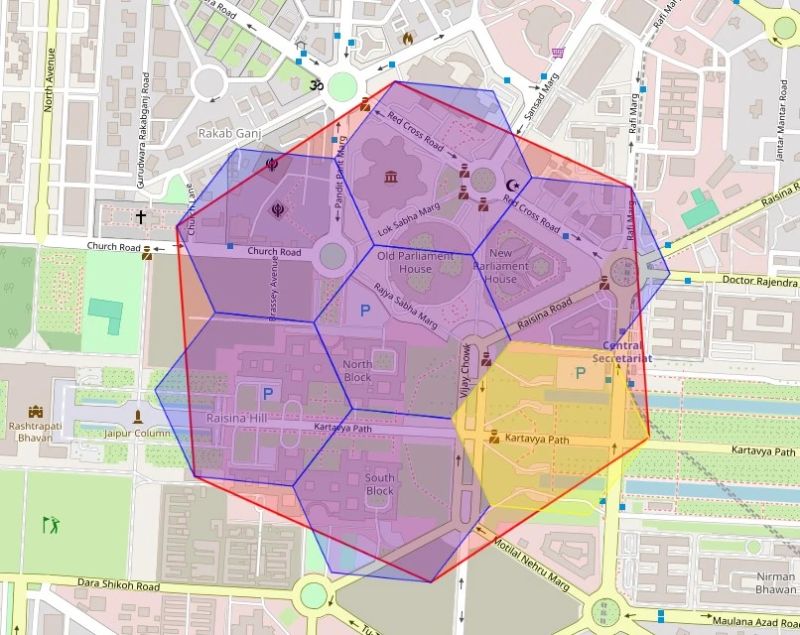
But here’s the insight that surprised me—why hexagons instead of squares?
Because square corners are 41% farther from center than edges (Corner Bias). Hexagons have uniform neighbor distances. Every neighbor cell is equidistant from the center.
Uber’s H3 index now powers:
- Dynamic pricing across different locations
- ETA calculations
- Driver positioning and dispatch optimization
The Math Behind Hexagons
Square Grid:
┌───┬───┬───┐
│   │ d │   │    d = distance to edge neighbor
├───┼───┼───┤    d√2 = distance to corner neighbor (41% farther!)
│ d │ X │ d │
├───┼───┼───┤
│   │ d │   │
└───┴───┴───┘

Hexagonal Grid:
    ╱╲   ╱╲
   ╱  ╲d╱  ╲     All 6 neighbors are equidistant
  ╱ d  ╲╱ d  ╲   No corner bias
  ╲    ╱X╲    ╱   Uniform spatial queries
   ╲  ╱  ╲  ╱
    ╲╱ d  ╲╱
The Smoothness Illusion
Then there’s the smoothness illusion. GPS updates every ~4 seconds. Networks drop packets. Raw data would make cars teleport around the map.
The solution combines two techniques:
- Dead Reckoning - Predicting position from speed and heading between GPS updates
- Kalman Filters - Blending prediction and measurement, trusting GPS when strong, prediction when weak
// Simplified Kalman filter concept
interface State {
  position: [number, number];
  velocity: [number, number];
  uncertainty: number;
}

function update(state: State, gpsReading: Reading): State {
  // Calculate Kalman gain based on GPS signal strength
  const gain = state.uncertainty / (state.uncertainty + gpsReading.uncertainty);

  // Blend prediction with measurement
  const newPosition = [
    state.position[0] + gain * (gpsReading.position[0] - state.position[0]),
    state.position[1] + gain * (gpsReading.position[1] - state.position[1])
  ];

  return {
    position: newPosition,
    velocity: estimateVelocity(state, gpsReading),
    uncertainty: (1 - gain) * state.uncertainty
  };
}
The Kalman filter essentially asks: “How much should I trust this new GPS reading vs. my prediction?” When GPS signal is strong (low uncertainty), trust the reading. When it’s weak (high uncertainty), trust the prediction.
The Pattern
The pattern repeats across every major system at Uber:
- Start simple - Polling, square grids, raw GPS
- Hit a fundamental limit - DDoS, O(N×M), teleporting cars
- Rethink entirely - gRPC/QUIC, H3 hexagons, Kalman filters
That’s real engineering. Not adding more servers to a broken architecture, but recognizing when the approach itself is the problem.
The next time you open a “simple” app, remember: years of distributed systems research might be hiding behind that smooth interface.
Have thoughts on distributed systems or want to discuss engineering patterns? Let’s connect!
Elyor Djalalov
Katta dastur muhandisi. Veb-dasturlash, dasturiy ta'minot arxitekturasi va muhandislik haqida yozaman.
Barcha maqolalar →